County Kerry covers the south-western tip of Ireland, renowned for its rugged hills and scenic beauty. Each of those peninsulas sticking out into the Atlantic Ocean is worthy of a week's discovery. We only have three full days and deteriorating weather. How an earth are we going to do them justice? And will we spot any Merrows?
Merrows? They live in Tír fo Thuinn, the Land Beneath the Waves, surfacing along the Kerry coast to interact with fishermen, warn of storms, marry humans, or lure them to their death. They move between sea and land using a magical red cap, the cohuleen druith, which allows them to breathe and travel underwater.
After a bit of research our itinerary pans out like this.
Day 1 - Sun 18 Oct - the Ring of Beara
We have sunny weather, and Beara with its coastal views, high pass and being not quite as famous as its siblings gets today's nod.
We head for Glengarriff on the coast, but there's a nice little waterfall a bit off the beaten track at Esknamucky that's worth a look. Pauline's getting increasing anxious as we descend into the valley with the road getting narrower and narrower, the turns tighter and tighter, and the grass on the centre strip greener and wider. When it seems we're about to end up in a farmer's paddock we're spat out at a parking area and an absolutely delightful little stream.
A 15 minute walk upstream brings us to the waterfall. Perhaps no great shakes by NZ standards, but a great way to stretch legs after an hour's drive.
As we make our way down the coast we hit the turn-off to the Healy Pass. We don't need to cut across the peninsula as there's lots to see further south, but the prospect of a twisty mountain pass is too good to refuse. As we negotiate the hairpins on the way up I'm thinking how good this road would be to do on two wheels.
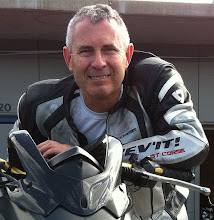
It appears others have a similar idea.
There are reminders that we're still on the WAW as we stop at the Gour lookout.
We hit the beach at Allihies
and are disappointed to find the nearby Copper Mine Museum closed from mid-October. Bummer - missed it by three days. While travelling in mid-autumn means we're not fighting for space with thousands of other tourists, it does give us some challenges with the weather and finding cafes and attractions closed.
But no matter.
Around every corner we come across jaw-dropping vistas, but can't photograph them all.
The Ring of Beara? We'll give it a 9 out of 10, and it's our fault it didn't score a perfect 10 as we arrived a few days late.
Day 2 - The Slea Head Drive on the Dingle Peninsula
For consistency this should be called the Ring of Dingle, as just like Beara we take a clockwise loop along the coast to the extremities of the peninsula, but the Slea Head Drive it is.
Before setting off we need to clear the ice from the windscreen - the first time we've experienced a frost on the trip.
First stop is Inch Beach.
But we didn't really come to Ireland for the beaches. There are derelict castles to see (this is Minard Castle)
and sheer cliffs at Ceann Trá
But the most unexpected pleasure was the Blasket Centre near Dunquin.
Behind Pauline are the Blasket Islands, just 5km from the tip of the Dingle Peninsula. In the early 1900s this was a thriving Irish‑speaking community of fishermen, storytellers, and writers, but life was hard and over time the young men and women left the islands, either to the mainland or to Springfield, Massachusetts in the USA.
The island was evacuated in 1953, when the population had dwindled to such an extent it was no longer viable for anyone to live in such a remote location.
The Blasket Centre is a museum dedicated to their memory, and it's extraordinarily well done.
Each of the major writers is described, and community and fishing life graphically displayed.
Outside are representations of Blasket women and a child at a water well.
The sculptor took inspiration from the Merrows that were known to inhabit the ocean off the Dingle Peninsula. Legend has it that a fisherman stole a merrow’s red cap, forcing her to live on land and marry him. She bore children but eventually found the cap and returned to the sea.
Pauline is intrigued by the mosaic patterns created by the dry-stone walls as they climb up from the glaciated valley floor.
On to the Gallerus Oratory, a masterpiece of early Irish engineering.
Built around the 7th or 8th century using dry-stone corbelling, its self-supporting arch-like roof and walls that shed rain outwards means it's remained standing after centuries of Atlantic weather. It's original purpose was as an early Christian church, monastic prayer cell, or perhaps a funerary chapel for a local chieftain.
After looping back to Dingle town we have an opportunity for another pass to see the northern beaches. How could we resist? From the crest of the Conor Pass we have fantastic views to the south where we've come from
to the north where we're going.
The Femoyle beach? Well - it's got hills, water and sand. A lovely beach, but perhaps we don't need to visit every one.
We skip the Castlegregory beach and head back south by yet another pass. Pauline's driving and would rather not as the narrow twisty roads with poor visibility increase her stress levels. I'm happy to take the wheel until we hit the coast and she takes us home. Dingle gets a 10/10.
Day 3 - two Rings for the price of oneOur luck with the weather hasn't lasted. We wake to heavy cloud and the prospect of later rain. We'd anticipated this and chosen to do the Rings of Kerry and Skellig due to their low passes and more indoor activities.
We set off early for Muckross Abbey in the Killarney National Park on our way to the Ring of Kerry. The abbey was a Franciscan friary, established in 1448.
Like many other Catholic institutions it suffered repeated raids from the English, culminating with the friars' eviction in the Cromwellian period. It's now roofless but remarkably intact, meaning we can wander through the chambers and stairs on three levels. A huge, twisted yew tree, possibly as old as the Abbey itself, is situated in the cloister in the heart of the abbey. Apparently it's the most photographed tree in Ireland, so of course we had to add to the tally.
We pass through Kenmare and climb up to to Moll's Gap for a coffee. It hasn't started raining yet so get some great views out over the valley.
The Avoca cafe and shop stocks a superb range of woollen
and coffee products. I was so conflicted by this decision I couldn't buy anything at all.
As we're descending to the coast I'm getting more and more frustrated with the Leon, its noisy ineffective transmission, and heat lost from the brakes. As you do, I start fantasising about a solution. What if I can find a rainbow, follow it to its end, capture the leprechaun guarding the pot of gold, and put him to work under the bonnet slowing the car by converting gravitational potential energy into petrol to be added back into the tank. Works for an EV, so why not an ICE? Sadly I don't think my fantasy will be realised any time soon.
We make our way down the eastern side of the Iveragh Peninsula through Sneem and Waterville. The Ring of Kerry starts heading north at this point, but if we hang a left we can do the Skellig Ring as well. It's raining cats and dogs (but not leprechauns) at this point, so the viewpoints get passed by in favour of Portmagee for lunch, and a trip over the bridge to Valentia Island.
Pauline found this one for me. She mentioned something about a cable, and with a raised eyebrow I had visions of a cable car journey in the driving rain. But no, she's discovered the Eighth Wonder - the Valentia Transatlantic Cable Station.
Remember the story (from my childhood, maybe yours too) of Robert the Bruce who while hiding in a cave watched a spider trying to anchor a thread across a gap? The spider tried and failed repeatedly, but eventually succeeded. He took this as inspiration to resume his fight against the English and eventually won the Battle of Bannockburn in 1314, securing Scottish independence. This perseverance theme is repeated in American William Hickson's well known phrase, "If at first you don’t succeed, try, try again".
When we send an email to the other side of the world we assume naturally it will be in the recipient's mailbox in a few seconds, or a minute or two at the most. But consider what it was like in the mid-1800s. A message between North America and Europe took two weeks by boat - weather permitting.
Cyrus Field, a New York paper merchant, had a dream. He wanted to lay a telegraph cable across the Atlantic, linking North America and Europe. Valentia Island was chosen as the landing point. He started in 1857 and the cable snapped. He tried again, and the cable snapped again. In 1858 after multiple failed attempts, the cable was finally completed and the first messages transmitted to great fanfare. After four weeks, the cable died. Continually taking inspiration from the spider, Field remained undeterred, tried again and again, and in 1866 finally managed an enduring cable. The Victorian era Internet is born - at a few words per minute by Morse code. By the 1890s it had risen to 50 words per minute. In the 2020s with fibre-optic cables it's measured at over 84 billion words per minute.
Pauline is checking out her Morse code skills.
The two rings? An 8/10, rising to a 10/10 in good weather and more time.
A dash for home and we count off our successes - the Ring of Beara, the Ring of Kerry, the Skellig Ring, and the Dingle peninsula. There's only one big one to go - the Mizen Peninsula. But will the weather play ball?
Day 4 - Mizen, east and the end of the WAW
Yesterday's rain has passed over, but squally showers are still blasting through. We decide to take a punt on the Mizen Head signal station, sitting at the very tip of the Mizen Peninsula, the most south‑westerly peninsula in Ireland. If we'd had the time we'd have taken in the adjacent Sheep's Head peninsula as well - but we cant do everything. It'll be a long day anyway.
It's a couple of hours to get down there, but it's well worth the trip.
There was never a proper lighthouse on Mizen Head - just a beacon, radio equipment and explosives for fog warnings. The station was fully automated and keepers withdrawn in 1993, with the buildings now used as a visitor centre.
The main lighthouse on the south coast is Fastnet, which you can see in the distance, 6.5km away to the south-east.
The the iconic footbridge over the gorge to the station is 45m above the surf crashing into the rocks below. Your heart's in your mouth as you look down.
And wherever there's a down, there must be an up, with a good aerobic effort to accompany it.
The WAW is pretty much over at this point, and we have no argument that the leading W in WAW really does stand for Wild. It's been a blast, literally and figuratively.
We head towards the south-east coast, skirting school traffic in Cork and rush-hour traffic in Waterford to arrive at our BnB in New Ross a bit after 6pm.
It's been a long day, but we have a whole new lot of experiences to plan. A Rock, perhaps? As if we haven't seen enough already? Stay tuned.


No comments:
Post a Comment